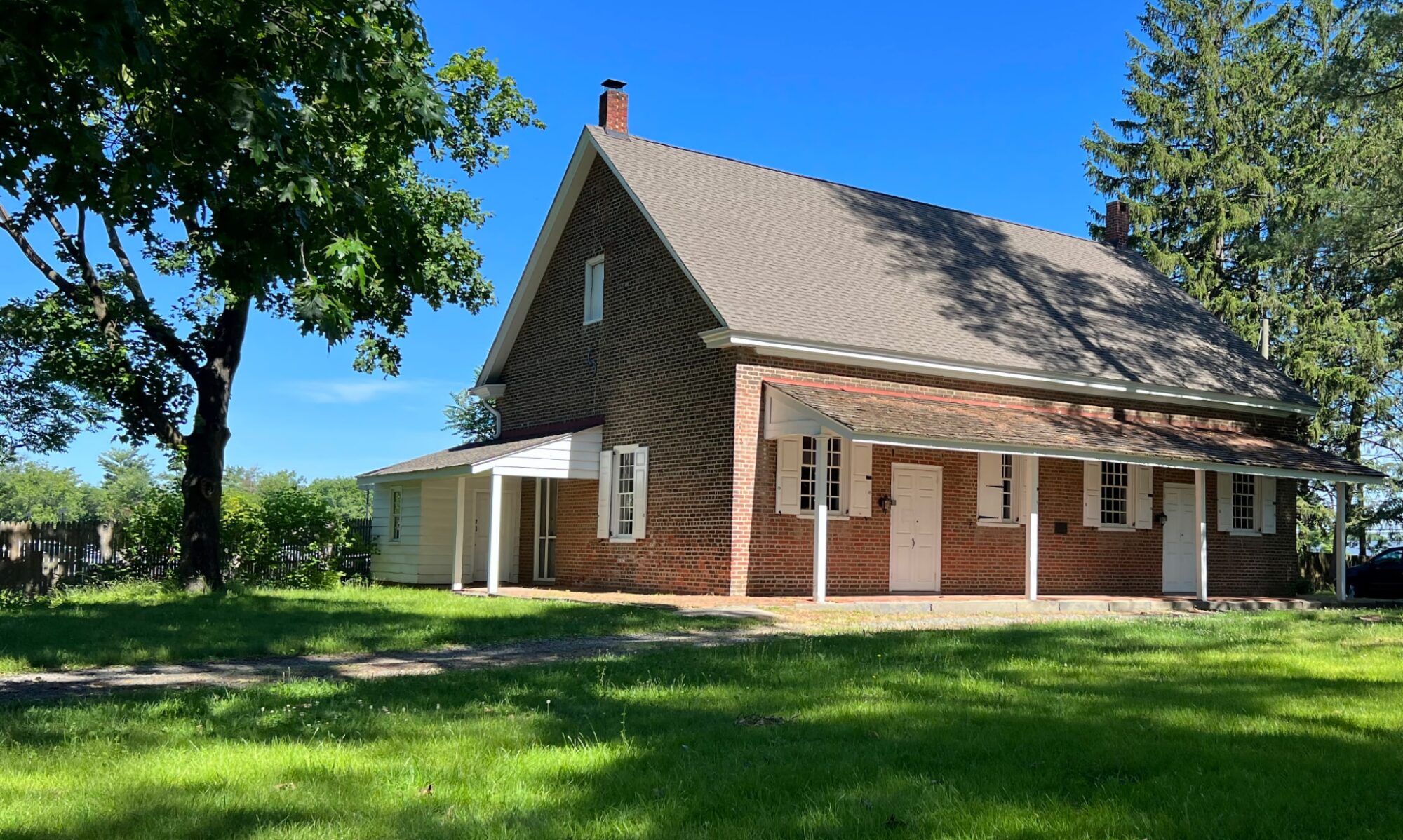
Cropwell Meeting hosts discussion of local Black history

Over three dozen local history enthusiasts came to Cropwell Meeting this Sunday to hear a presentation by Paul W. Schopp on antebellum free Black communities in the Marlton area. Schopp is a historian who has been researching historic Black South Jersey towns for over three decades. He has identified 140 “fugitive slave enclaves” in the southern counties of the state. Milford, New Jersey (later renamed Kresson) was one such town, whose residents enjoyed longstanding connections to Cropwell Meeting.

Schopp set up the history: in 1776, Philadelphia Yearly Meeting decided that no members could hold slaves. With slavery ended in the Religious Society of Friends, Quakers in Southern New Jersey began lobbying the colonial—and later state—government to allow for easier manumissions and total abolition. [A law for gradual abolition passed the state legislature in 1804.]

The woods of free South Jersey began attracting Africans in bondage, especially from Maryland. As the number of free Blacks grew, enclaves attracting fugitive slaves began to develop. Schopp stressed that these enclave towns were not “stops” on the Underground Railroad (temporary resting places before travel elsewhere) but “terminals”—towns where escaping enslaved people settled. Timbuctoo outside Mt Holly served as a template for these communities. These settlements were often on the margins of White communities or in rural districts, usually on sandy land with only marginal productive use. The men often worked in local brickyards; the women as house servants.

Schopp finished by regaling the audience with heart-stopping stories of slave catchers who kidnapped whole families and the White abolitionists who went back into slave territory in disguise to negotiate for their return to South Jersey.

The audience was fascinating mix. The meeting had publicized the the talk among local historical societies and African American history networks. The talk attracted members from area Quaker families; a member of Milford’s Truitt family (whose grandmother worshiped at Cropwell in the early twentieth century); a docent from the African American Museum in Philadelphia; sisters who had grown up in Milford/Kresson decades ago; as well as a number of local history buffs.

Many of the attendees came early to attend Cropwell’s worship service. The meeting’s clerk made sure to go around the room welcoming everyone in turn and inviting them to share where they were from and why they had come. A number of attendees said it was their first Quaker meeting for worship.

At worship, the clerk asked a member to read from a 1966 memoir, Answered Prayers, by Paul S. Lippincott Jr., a recorded minister and lifelong Friend at Cropwell. Here is part of that reading:

With this background of the Society of Friends, which is more or less mystical religion, it would probably account for one of the early experiences I had when I was in my late twenties or early thirties. I had been reading some religious books before retiring for the night, and after a short period of prayer it became very clear to me that I should go out and gear up the horse. Not having any car in those days, or any electricity, I lighted the old kerosene lantern and went out to the stable and harnessed the horse. It was very clear to me as I went out the lane that I turn settlement about 2 miles west of Marlton, known as Milford. Since there was a Milford in North Jersey the name was later changed to Kresson. In this settlement was a little country store which was still lighted on this particular evening. Without any preparation at all it seemed to me that I should stop at the store and purchase some staple items of food for someone. Until that time I had no idea where I was going to take this food, but after purchasing some canned food and staple items that could be kept for a few weeks without refrigeration, I remembered an old colored lady named Margaret Worthington, who lived in a cabin by herself. I had never met her but I felt that I was to drive in that direction. In about ten minutes I pulled up at the little one room cabin where there was a light through the window, and as I went to the door, I heard her voice praying for help and food. I was there under unusual circum stances to answer the fervent prayers of a believing soul. I left the food and that was the beginning of an unusual friendship.

1885 map showing Milford (Now Kresson), NJ. Via boydsmaps.com.
Mary Truitt Jackson home in Milford (Kresson), N.J. Left: Members of the Truitt Family purchased land from Cropwell Meeting’s Evans Family as early as 1834. Photo from “Unearthing Evesham’s Forgotten History,” a talk sponsored by Evesham Township on Feb. 23. An interactive slideshow from this event is available here. The scan is attributed to the “MATM Collection,” copyright 2019; we’ve cleaned it up. Schopp says it’s from the collection of Patti Colston.

Two Truitt descendants, Damon Truitt and Patti McGee Colston, were featured in the Roots Less Traveled TV show last year, much of which was filmed at Cropwell Meeting. Damon came to Cropwell for the event.

War Vet and Pacifist George Rubin Comes to Cropwell

World War 2 war vet and Quaker George Rubin came to Cropwell Meeting this Sunday to tell how his first-hand experience of the horrors of war turned him into a Quaker pacifist.

George told the audience how excited he was to leave Brooklyn as a teenager for the chance to see the world through combat. Assigned to a B-17G Flying Fortress, he found himself at the age of 19 stationed in England and flying regular bombing raids over Germany. In the winter of 1944-45, the U.S. began targeting civilians in order to break German morale. Some of Rubin’s crewmates had decided they wouldn’t fly these missions; the others stayed up in their quonset huts debating whether they would stand with them, an act of defiance that would certainly bring on a court martial.

George with a model of the plane he flew on.

The next day they were sent on a mission to Munich. Anti-aircraft flak was the biggest danger to aircraft going into 1945 and at 30,000 feet, on a beautiful Sunday winter day, they were hit. Two engines gave out and the plane was riddled with 270 holes. George Rubin’s leg was seriously wounded but he was tasked with lightening the load by jettisoning the bombs so that the crippled plane might make it to neutral Switzerland. Going into the bomb bay in negative 28° degree weather, he made sure to put the Carter pins back into the bombs warheads so they wouldn’t explode when they fell on the towns below.

They crashed in Germany, in a field next to a camp of Nazi Youth Training Corp and were about to be executed when a German officer stopped the proceedings and they became prisoners of war. They were marched to Nuremberg and south of Germany and endured the battle as General Patton’s army liberated the POW camp.

George Rubin came out of these experiences knowing he would never fight again. “Human beings are too precious,” he told the rapt audience at Cropwell. A decision that started in a Quonset hut in England and finally made on the road to Nuremberg.

The Cropwell Meeting audience was captivated by George’s storytelling.

Back home in Brooklyn, George’s wife Margery found Quakerism and they had a community that supported their new pacifist views. George has served Friends in many capacities, including as clerk of New York Yearly Meeting. He is a member of nearby Medford Meeting.

George has continued to work for peace over the almost eight decades since that fateful winter. He told the Cropwell audience that there is a behavioral center for Veterans a few blocks from the meetinghouse. He meets with other vets every week. “I’m the antique of this bunch,” he told the meeting, explaining that most are vets there from Vietnam and Afghanistan and Iraq. “They all have PTSD. This is what the ‘good war’ does to all of us.”

He told the audience of the scene at the Philadelphia VA Hospital, where so many vets are there for drugs because they’re suicidal. “We sent them to fight and then forget about them. We don’t know the devastation we’re doing to each other.“

Many years later, George Rubin traveled to the German town where his plain crash landed and met with the mayor and former German soldiers. The crash site is still a field, protected from development and the mayor confirmed that none of the bombs George jettisoned out of the plane that freezing morning exploded.

Toward the end of the event, two sisters in the audience rose to tell the story of their father, who had also flown bombing missions over Germany. They recalled the PTSD that kept him from ever talking about that part of their life with them, and showed family memorabilia of his military life.

George Rubin ended his presentation with a reading of “Prayer for Peace,” written by Norman Corwin and dedicated to his brother LT. Alfred Corwin. It was originally written for a radio broadcast in 1945 called “On A Note Of Triumph.” (A documentary on Corwin can be watched here).


More:

You can read more about George’s pacifist positions in his 2015 article for Friends Journal magazine, “A Letter from a Warrior.

Talk on the Modern Labor Market

On Sunday, March 12, University of Pennsylvania associate professor Roberta Iversen presented a talk at Cropwell Meeting about the challenges of today’s labor market. She shared what working people in many different fields been saying about their work and what does their job means to them? She told us about major industry shifts in the 1980s?

Dr. Iversen brought 40 years of stories, research & analysis, as well as an innovative proposal for its future. She is author of the new book What Workers Say: Decades of Struggle and How to Make Real Opportunity Now.” Through these stories, Iversen put a human face to the labor market and tracked its evolution.


Promotional flyer for event.

Electrical and Safety Upgrades in Meetinghouse, Thanks to Yearly Meeting Support

Cropwell’s infrastructure got a big upgrade this week. Thanks to a generous gift from the Philadelphia Yearly Meeting Granting Group, the building’s electric was rewired, and fire safety upgrades and security lighting were installed. The work was done by Front Line Electric of Glendora, N.J., who were prompt, professional, and courteous.

The Cropwell Friends Meetinghouse, built in 1809, was very much in need of work. The last known update to the electrical wiring took place in the 1920s. The type of wiring used at that time was “knob-and-tube,” which does not have a ground system for safety. This doesn’t necessarily make the wiring unsafe to use, but it does rule out important safety features and leaves appliances and sensitive electronics vulnerable to damage from power surges.

Exterior lighting was also installed for safety and security purposes.

Stewardship and Community

The work on the meetinghouse spoke to the stewardship and community testimonies of Friends.

The current Cropwell Meetinghouse structure was built in 1809. It is on the historic registry but like all old buildings, it has needs and those needs have price tags. It is our responsibility to be good stewards to maintain the structure for current and future members.

Cropwell has a small number who attend regularly, but there is cohesion and commitment which has increased in intensity over the past year, and there is an openness to increasing and strengthening that community. We have received letters requesting membership from four individuals within the last year and have received loving support from members within Haddonfield Quarter.

Chair Yoga Intro Class

On Sunday Peggy Koenitzer came to Cropwell Meeting in Marlton, N.J., and gave about a dozen participants introductory lesson on chair yoga. Breath in, breath out, and stretch!

  • Practice yoga poses to strengthen and stretch your muscles while sitting in a chair
  • Learn to use a chair for support in standing or balancing poses
  • Discover the benefits of coordinating your breath and movement to calm your mind and let go of stress
  • Release tension and restore energy in a deep relaxation at the end of your Chair Yoga practice

Peggy teaches yoga as Release and Relax yoga at the Lake Pine Colony Clubhouse in Medford, New Jersey. Learn more at Releaseandrelaxyoga.com.


Promotional flyer for event.

Cropwell Calendar

March 8, 2026
  • Cropwell Worship
    March 8, 2026  10:00 am - 11:00 am

  • Meeting for Business
    March 8, 2026  11:00 am - 12:00 pm

    On the second Sunday of every month we stay after worship to discuss everything from finances to property needs to upcoming events. Visitors are welcome to participate and see Quaker process in action!

March 15, 2026
  • Cropwell Worship
    March 15, 2026  10:00 am - 11:00 am

March 22, 2026
  • Cropwell Worship
    March 22, 2026  10:00 am - 11:00 am

See the Full Extended Calendar. You can see write-ups of recent events along with old flyers in our News & Archives page.

Christmas Caroling Comes to Cropwell

About three dozen people came out to a community carol singalong at Cropwell Friends Meeting in Marlton, N.J., this past Sunday. The meeting hired three members of the Parson Brown Singers to perform a dozen Christmas classics and lead the group in a singalong of another ten crowd favorites. A highlight was a highly interactive “Twelve Days of Christmas,” for which participants were divided into twelve sets and each given a day to sing and represent in mime. The event finished with cookies, sweets, mulled cider, and conversation as Friends old and new shared stories in the fellowship section of the meetinghouse.

Winter seasonal events are a natural opportunity for community outreach, especially for a Friends meeting with an historical building. The wooden benches, roaring wood stove and singers in Victorian garb instantly set a mood.

The organizers listed the event on Google Events and Eventbrite, as well as Instagram and Facebook (where the meeting bought some event advertising). At the November meeting for business, members had deliberated whether to charge an attendance fee to recoup some of the cost for the singing group, but after discussion and careful discernment the sense of the meeting was that this would be an important outreach event and that expenses should be paid out of meeting funds to allow the event to be free for participants.

A special program is a great event to invite extended networks to visit the meetinghouse: regular Cropwell attenders brought along parents, adult children, neighbors, and friends. The meeting also reached out to lapsed attenders with an invitation to the festivities. It is hoped that some of these new and irregular visitors might come back for worship in the near future.

The interactive “Twelve Days of Christmas” got the audience on their feet.

Promotional flyer for event.

Origami Craft-making Workshop

Cropwell Friends Meeting in Marlton, N.J., held a free public craft-making workshop after worship today. Joan Morrison of Haddonfield Public Library led about a dozen members and visitors in folding paper Christmas wreaths.

Origami crafts are great opportunities for multigenerational fellowship and there was a wide age range of participants gathered in the fellowship section of the meetinghouse. Many laughs were had as papers were folded and refolded. Each section took 12 folds and it took 12 sections to make a full wreath. A full spread of potluck items including chicken, salads, pies, cornbread, and cookies made for a fun lunch afterwards.

Google Events listing

The publicity for the website went out over the standard channels—email, website, Facebook, and Instagram. In addition, members of the nearby homeowners association were invited and the meeting also posted it to Google Events. A listing was placed on the yearly meeting and South Jersey Quakers websites.

Much of the publicity packaged this event together with an upcoming caroling performance and singalong, together dubbed “Christmas at Cropwell.”

Promotional flyer for event.

Quaker Peace Testimony Talk

Cropwell Meeting held an introductory program on the Quaker peace testimony on Sunday afternoon. Geared toward newcomers, presenter Martin Kelley gave a 25 minute overview of the history of Quaker peacemaking, from the foundational 1660 Statement to more recent expressions of Quaker peacemaking, such as the climate-change advocacy of the Earth Quaker Action Team and the “Statement on the Peace Testimony and Ukraine” release in late October.

About a dozen participants stayed afterwards for a robust discussion, during which they shared concerns but also stories of inspirational peacemakers they have known. Informal discussions continued at the potluck meal that followed.

Samples from the presentation slideshow, clockwise from upper left: Quaker relief efforts for victims of the Spanish Civil War; Black soldiers train on Quaker-owned land during the U.S. Civil war; protesters from the Earth Quaker Action Team urge financial institutions to divest from investments contributing to climate change in a recent demonstration; four activists associated with Friends prepare to disrupt U.S. nuclear atmospheric testing on the Golden Rule in 1958.

Cropwell Friends planned this program after identifying the peace testimony as a stumbling block for some of its new attenders. In particular, some have expressed personal doubts about the Quaker peace testimony in the face of the brutality of the war in Ukraine. The program was designed to give a clearer understanding of the theological and historical roots of Quaker peacemaking and to share how Friends have responded to difficult moral dilemmas in the past.

Banner photo: 1930s-era leaflet from the American Friends Service Committee used to solicit support for refugee support work during the Spanish Civil War. Learn more.

Neighborhood Trunk or Treat

Cropwell Meeting held its first annual Trunk or Treat on Sunday, inviting neighborhood families over for games, treats, a pumpkin hunt, and tours of the meetinghouse.

The area around Cropwell has changed quite a bit since Friends first settled there in the 1780s. A patchwork of Quaker family farms has given way to twenty-first century suburbs, and today the meetinghouse property is an oasis of open space in a built-up area of housing developments. Few of the neighbors have ever visited the meetinghouse.

Cropwell contacted the homeowners association for the adjacent Marlton Village development, which agreed to distribute 210 Trunk or Treat flyers to its families. Cropwell also announced the event on its Facebook page and website.

About thirty neighbors showed up. The kids came with great costumes (princesses, dragons, tigers, at least one ninja), while parents came with lots of questions about Friends. “I didn’t know this building was still used for anything,” one told us, adding “I love history!” There were many tours of the 1809 meetinghouse, in which Cropwell clerk Earl Evens and others shared the meeting’s history and explained Quaker worship. One parent said “you guys did a fabulous job” as she left a tour.

The visitors were all invited to come back for worship some future Sunday morning.

Cropwell clerk Earl Evens shares the story of the meeting with neighborhood families.